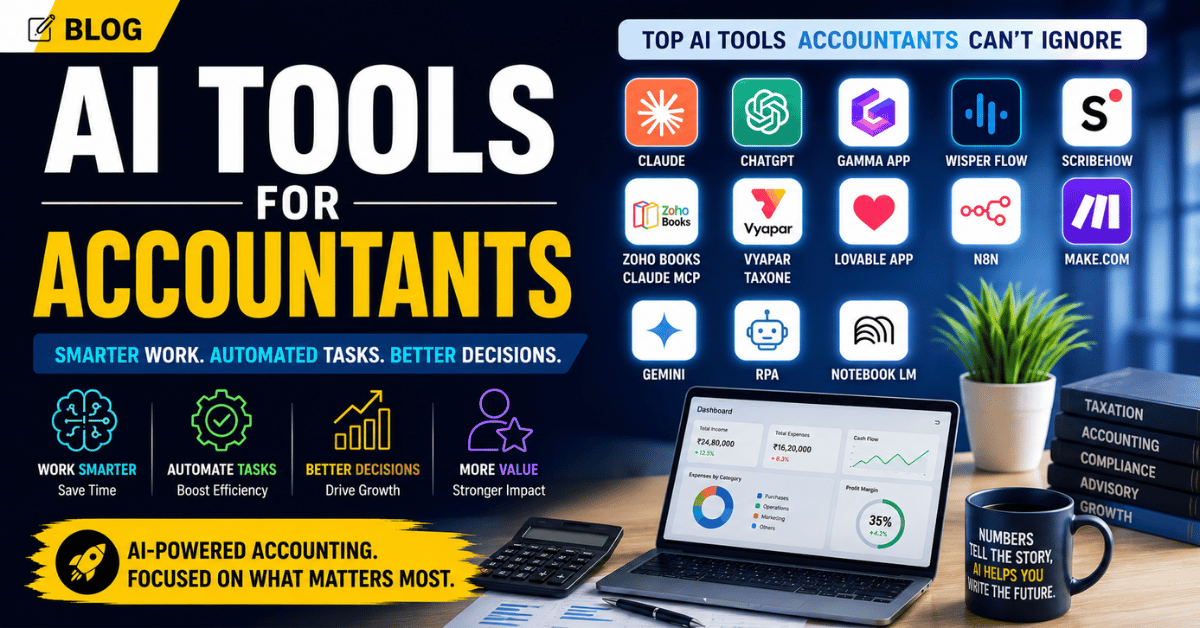
While most accountants are still learning new Excel shortcuts…
A new generation of AI-powered accountants is building automated firms, creating content daily, handling clients faster, and scaling without massive teams.
This shift has already started.
The accounting profession is no longer just about:
- Filing returns
- Maintaining books
- Preparing reports
- Doing repetitive compliance work
The modern accountant is becoming:
- A consultant
- A systems thinker
- A digital advisor
- A content creator
- An automation expert
And the biggest difference between average accountants and future-ready accountants may soon be one thing:
Their ability to use AI.
Because the real threat is not AI.
The real threat is another accountant using AI better than you.
Why AI Matters for Accountants
AI is helping accountants:
- Save time
- Reduce manual work
- Improve communication
- Automate operations
- Scale services
- Build digital systems
- Increase profitability
Earlier:
- You needed a large team to grow.
Now:
- One smart accountant with AI tools can operate like a mini company.
This is the biggest transformation the accounting industry has seen in decades.
Let’s explore the AI tools modern accountants should start learning.
1. Zoho Books + Claude MCP – The Beginning of AI Accounting
Zoho Books
This is where accounting is heading.
MCP (Model Context Protocol) allows AI assistants like Claude to interact directly with software like Zoho Books.
Imagine saying:
- “Show clients with overdue invoices.”
- “Analyze cash flow problems.”
- “Generate business insights.”
- “Find suspicious transactions.”
And AI performs those actions instantly.
No manual searching.
No endless clicking.
Just conversation-based accounting workflows.
This changes accounting software from a dashboard into an intelligent business assistant.
The future accountant may spend less time operating software…
and more time making decisions.
2. Claude – Your AI Article Assistant
Anthropic
Most accountants deal with:
- Notices
- PDFs
- Agreements
- Financial reports
- SOPs
- Compliance documents
And reading all of them manually consumes enormous mental energy.
Claude is one of the most powerful AI tools for deep reasoning and document analysis.
You can upload large documents and ask:
- “Summarize this GST order.”
- “Draft a professional reply.”
- “Explain this tax issue simply.”
- “Create an SOP from this process.”
Instead of spending 2 hours understanding a document…
you may get clarity within minutes.
This is not just productivity.
This is leverage.
3. Gamma App – Create Professional Presentations in Minutes
Gamma
Most accountants are not designers.
Yet they spend hours creating:
- Webinar slides
- Client presentations
- Training decks
- Workshop material
Gamma eliminates that struggle.
You simply type:
“Create a presentation on GST for freelancers.”
And it generates:
- Structure
- Slides
- Design
- Visual formatting
Automatically.
For educators, consultants, and creators, this is a massive advantage.
Because in today’s world:
The accountant who communicates better often grows faster.
4. Whisper Flow – Turn Thoughts into Content
WhisperFlow
Many professionals think faster than they type.
Whisper Flow converts your voice into structured text instantly.
This means you can:
- Draft emails while walking
- Record SOPs verbally
- Capture content ideas quickly
- Create documentation faster
Instead of staring at a blank screen…
You simply speak.
For busy accountants managing clients, meetings, and deadlines, this can save hours every week.
5. ScribeHow – Build SOPs Automatically
Scribe
One of the biggest problems in accounting firms is this:
Knowledge stays inside employees’ minds.
And when people leave…
processes break.
ScribeHow helps solve this beautifully.
It records your screen activity and automatically creates:
- SOPs
- Step-by-step guides
- Training documents
- Screenshots
Imagine creating:
- GST filing SOPs
- Client onboarding systems
- Zoho Books workflows
- TDS process documentation
Without manually writing everything.
Smart firms are becoming system-driven instead of people-dependent.
6. ChatGPT – The Digital Brain of Modern Professionals
OpenAI
Everyone knows ChatGPT.
But most accountants are using only 5% of its potential.
ChatGPT can help with:
- Client emails
- GST explanations
- Tax summaries
- Marketing content
- Webinar scripts
- Excel formulas
- Proposal drafting
- Social media captions
The real power of ChatGPT is not information.
It is speed.
Tasks that earlier took:
- 2 hours
- Multiple revisions
- Team coordination
Can now happen within minutes.
The accountants who learn prompting properly will have a massive productivity advantage.
7. Gemini – AI Inside Google Workspace
Google
Gemini
If your work already happens inside:
- Gmail
- Google Docs
- Sheets
- Drive
- Meet
Then Gemini can quietly become your productivity assistant.
It helps with:
- Drafting emails
- Summarizing meetings
- Analyzing spreadsheets
- Creating reports
- Organizing information
Small time savings daily become massive advantages over years.
8. NotebookLM – Your Personal AI Research Assistant
NotebookLM
This may become one of the most underrated tools for accountants and students.
You can upload:
- GST Acts
- Circulars
- PDFs
- Financial reports
- Notes
- Tax documents
And ask questions directly from your uploaded material.
Example:
- “Explain Section 194Q.”
- “Summarize GST amendments.”
- “Create revision notes from this document.”
Instead of searching across 20 browser tabs…
You create your own AI-powered knowledge system.
9. Vyapar + TaxOne – AI in the Indian Compliance Ecosystem
Vyapar
TaxOne
AI adoption is not limited to Silicon Valley tools.
Indian accounting platforms are also evolving rapidly.
These tools help businesses with:
- GST billing
- Return filing
- Compliance workflows
- Reporting
- Tax calculations
The Indian compliance ecosystem is becoming more digital every year.
And accountants who understand technology early will build stronger practices.
10. n8n – Automation for Smart Firms
n8n
This is where operations become powerful.
n8n helps connect different apps and automate workflows.
Example:
When a lead fills a form:
- CRM updates automatically
- WhatsApp message gets triggered
- Email sequence starts
- Internal team gets notified
No manual coordination required.
Accounting firms can automate:
- Client onboarding
- Payment reminders
- Lead management
- Document collection
- Internal workflows
This reduces operational chaos significantly.
11. Make.com – Automation Without Coding
Make
Earlier, automation required developers.
Now accountants themselves can build workflows visually.
Make.com helps automate:
- Webinar registrations
- CRM updates
- Client reminders
- Email sequences
- Invoice workflows
Without coding.
This is important because the future belongs to professionals who understand systems.
Not just software.
12. RPA – The Silent Workforce Behind Modern Firms
Robotic Process Automation
Large firms are already using RPA extensively.
Because repetitive work kills scalability.
RPA helps automate:
- Invoice processing
- Data extraction
- Reconciliations
- Compliance workflows
- Report generation
The future accounting firm will combine:
- AI
- Automation
- RPA
- Cloud accounting
Together.
This creates leaner, faster, and more scalable firms.
13. Lovable App – Build Software Without Coding
Lovable
This may become one of the biggest opportunities for accountants.
For the first time, non-technical professionals can build apps using AI prompts.
Imagine creating:
- GST calculators
- Client portals
- Tax trackers
- Accounting dashboards
- Lead management systems
Without hiring developers.
The line between accountant and tech entrepreneur is slowly disappearing.
And the professionals who combine:
- Accounting knowledge
- AI
- Automation
- Software thinking
Will create entirely new business models.
Final Thought
The accounting profession is changing rapidly.
The firms that survive may not necessarily be the biggest firms.
They may simply be the smartest and most adaptive firms.
Because the future accountant will not just:
- File returns
- Maintain books
- Handle compliance
They will:
- Build systems
- Use AI
- Automate workflows
- Create digital assets
- Operate globally
- Scale faster with smaller teams
Start with one tool.
Learn it deeply.
Because over the next few years, AI skills may become just as important as accounting skills.