What Is Form 1040? A Complete Beginner’s Guide for Indian Accountants
If you’re an Indian accountant planning to build a career in U.S. accounting or taxation, Form 1040 is the first IRS form you should understand.
Just as every Indian tax professional learns the Income Tax Return (ITR) forms, every U.S. tax professional begins with Form 1040.
Whether you want to work with U.S. CPA firms, prepare tax returns for American clients, or start a career in U.S. taxation, understanding Form 1040 is the foundation.
In this guide, you’ll learn:
- What Form 1040 is
- Who files it
- How it compares with India’s ITR forms
- What information it contains
- The schedules attached to Form 1040
- Common mistakes beginners make
- Frequently asked questions
Let’s begin.
What Is Form 1040?
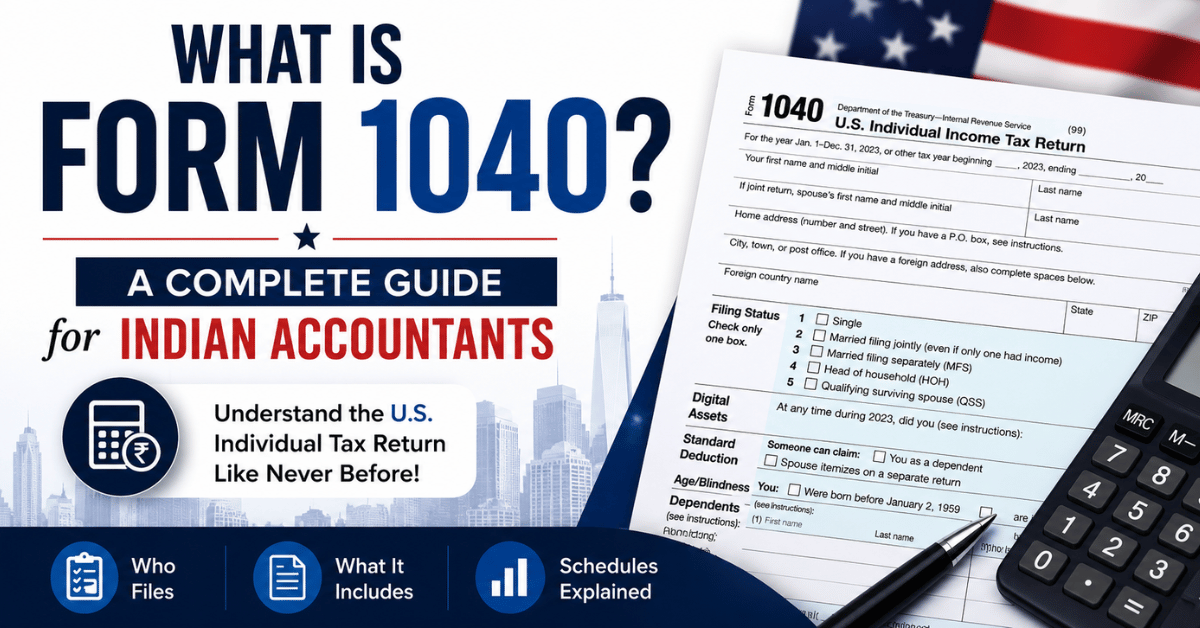
Form 1040 is the primary individual income tax return used in the United States.
It is issued by the Internal Revenue Service (IRS) and is used by U.S. citizens and most resident aliens to report their income, calculate their tax liability, claim deductions and credits, and determine whether they owe additional tax or are entitled to a refund.
Think of Form 1040 as the backbone of the U.S. individual income tax system.
Every year, millions of taxpayers submit this form to report their financial information to the IRS.
The Simplest Way for Indian Accountants to Understand Form 1040
The easiest way to understand Form 1040 is by comparing it with India’s Income Tax Return (ITR).
In India, we file different ITR forms depending on the taxpayer’s profile.
For example:
- ITR-1 for many individuals with straightforward income.
- ITR-2 for specified taxpayers with capital gains or multiple house properties.
- ITR-3 for business or professional income.
- ITR-4 for eligible presumptive taxation cases.
The return form changes depending on the nature of the taxpayer and income.
The U.S. system works differently.
Instead of changing the main return for most individuals, the IRS generally uses one primary return—Form 1040—and additional schedules for different income types and situations.
This is one of the biggest differences between the Indian and U.S. tax systems.
Who Files Form 1040?
Generally, Form 1040 is filed by:
- U.S. citizens
- Resident aliens
- Individuals who satisfy the Green Card Test
- Individuals who satisfy the Substantial Presence Test (unless an exception applies)
These taxpayers generally report their worldwide income on Form 1040.
Who Does NOT File Form 1040?
Not everyone earning income in the United States files Form 1040.
Many nonresident aliens are required to file Form 1040-NR instead.
Examples may include:
- Certain international students
- Visiting professors
- Researchers
- Foreign consultants
- Other nonresident taxpayers with U.S.-source income
The correct return depends on U.S. tax residency, not simply immigration status.
This is one of the most misunderstood concepts among beginners.
What Information Is Reported on Form 1040?
A typical Form 1040 includes information such as:
Personal Information
- Name
- Social Security Number (SSN) or other taxpayer identification information, as applicable
- Address
- Filing status
Income
The return reports various categories of income, such as:
- Wages and salaries
- Interest income
- Dividend income
- Business income
- Capital gains
- Rental income
- Retirement income
- Other taxable income
Adjustments
Certain adjustments may reduce taxable income.
Examples include eligible retirement contributions and certain education-related adjustments, subject to IRS rules.
Tax Calculation
The return calculates:
- Taxable income
- Federal income tax
- Self-employment tax (where applicable)
- Other taxes
Tax Credits
Eligible taxpayers may claim credits such as:
- Child Tax Credit
- Education credits
- Foreign Tax Credit
- Other credits permitted under U.S. tax law
Payments
The return reports:
- Federal tax withholding
- Estimated tax payments
- Refundable credits, where applicable
Refund or Balance Due
Finally, Form 1040 determines whether:
- The taxpayer receives a refund, or
- Additional tax must be paid.
Understanding Form 1040 Schedules
Unlike India’s multiple ITR forms, the U.S. system relies heavily on schedules.
Some common schedules include:
Schedule A
Used to claim itemized deductions when applicable.
Schedule B
Reports interest and ordinary dividend income above applicable thresholds and certain foreign account disclosures.
Schedule C
Used by sole proprietors and independent contractors to report business income and expenses.
Schedule D
Reports capital gains and losses.
Schedule E
Reports rental income, royalties, partnerships, S corporations, estates, and trusts.
Schedule SE
Calculates self-employment tax.
A good way to think about it is:
Form 1040 tells the taxpayer’s overall tax story, while the schedules provide the supporting details.
Form 1040 vs Form 1040-NR
One of the biggest questions beginners ask is:
“Who files Form 1040, and who files Form 1040-NR?”
The answer depends on tax residency.
Generally:
Form 1040
- U.S. citizens
- Resident aliens
Form 1040-NR
- Nonresident aliens
Many new learners incorrectly assume that everyone working in the United States files Form 1040.
That is not correct.
Common Mistakes Beginners Make
1. Assuming Everyone Files Form 1040
This is probably the most common mistake.
Nonresident aliens often need to file Form 1040-NR instead.
2. Confusing Immigration Status with Tax Residency
A visa category does not automatically determine which return should be filed.
Tax residency is determined under U.S. tax rules.
3. Ignoring Schedules
Many beginners focus only on Form 1040 and ignore the schedules.
However, much of the detailed tax reporting happens in the schedules.
4. Memorizing Forms Instead of Understanding the Process
Rather than memorizing every IRS form, first understand:
- Who is filing?
- What income do they have?
- Which schedules apply?
This approach makes learning much easier.
Why Indian Accountants Should Learn Form 1040
The demand for professionals with U.S. accounting and tax knowledge continues to grow due to globalization and cross-border outsourcing.
Learning Form 1040 can help Indian accountants:
- Work with U.S. CPA firms
- Build careers in U.S. taxation
- Provide tax preparation support services
- Understand U.S. individual taxation
- Expand opportunities in international accounting
Most importantly, it provides a strong foundation before moving on to more advanced areas such as business taxation, partnerships, corporations, and international tax.
Frequently Asked Questions
Is Form 1040 the same as an ITR?
Not exactly.
Both are individual income tax returns, but India uses multiple ITR forms, whereas the United States generally uses one primary Form 1040 with additional schedules.
Can a nonresident alien file Form 1040?
Generally, no.
A nonresident alien typically files Form 1040-NR unless a specific rule allows or requires a different treatment.
Does everyone in the U.S. file Form 1040?
No.
The appropriate return depends on tax residency and other applicable tax rules.
Is Form 1040 difficult to learn?
Not at all.
Once you understand:
- Filing status
- Income
- Deductions
- Credits
- Tax calculation
- Schedules
the form becomes much easier to understand.
Final Thoughts
If you’re an Indian accountant beginning your journey into U.S. taxation, Form 1040 is the best place to start.
Don’t try to memorize every IRS form immediately.
Instead, focus on understanding:
- Who files Form 1040
- What information it captures
- How it differs from Form 1040-NR
- How schedules support the main return
- How the U.S. system compares with India’s ITR framework
Once you master Form 1040, learning the rest of the U.S. tax system becomes significantly easier because many advanced concepts build upon the principles introduced in this return.
The strongest U.S. tax professionals don’t just know how to fill out Form 1040—they understand the rules behind every number reported on it. That’s the mindset every aspiring Indian accountant should develop as they build expertise in U.S. taxation.