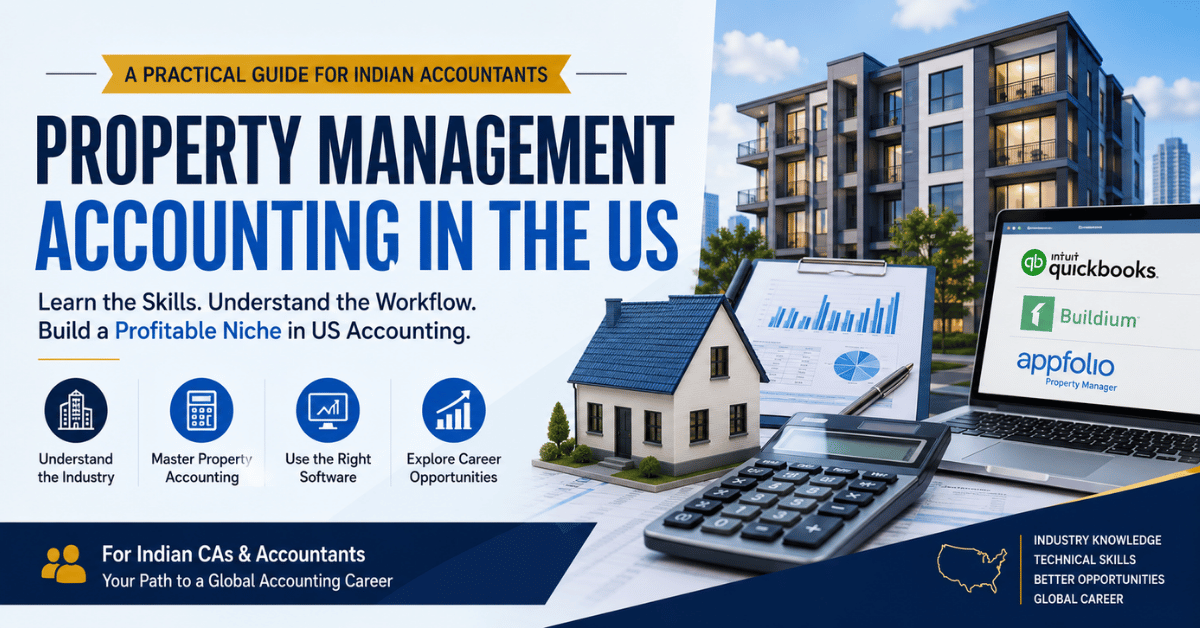
Why this niche can be an attractive entry point into US accounting—and what you actually need to learn
When Indian Chartered Accountants and accountants think about entering US accounting, the first things that usually come to mind are:
QuickBooks.
Bookkeeping.
Payroll.
1099s.
Tax preparation.
But there is another way to approach the US accounting market:
Start with an industry.
One industry worth understanding is US property management.
Property management accounting is not simply normal bookkeeping with a different client name.
The business has its own transaction flows, accounting requirements, reporting needs, software, terminology and operational challenges.
A property management company may collect rent from tenants, hold money for property owners, pay vendors, charge management fees, maintain property-level records, distribute funds to owners and produce financial reports for multiple properties.
For an accountant, this creates a recurring accounting workflow.
For an Indian CA or accountant trying to enter US accounting, that can create an interesting specialization opportunity.
This article explains the entire structure—from the basics to the technical concepts, software and potential service opportunities.
1. First, understand what a property management company actually does
Let’s start with a simple example.
Suppose a US property owner owns an apartment building but doesn’t want to manage it personally.
They hire a property management company.
The property manager may handle:
- Finding and communicating with tenants
- Collecting rent
- Paying property-related bills
- Coordinating repairs
- Paying vendors
- Maintaining property records
- Preparing owner statements
- Distributing available funds to owners
- Collecting a management fee
- Coordinating with accountants and tax professionals
Now imagine that the company manages 200 properties.
Suddenly, the accounting operation becomes much more complicated.
There could be:
- Hundreds of tenants
- Hundreds of vendor transactions
- Multiple bank accounts
- Multiple properties
- Multiple property owners
- Security deposits
- Owner reserves
- Management fees
- Repairs and maintenance
- Capital improvements
- Insurance
- Property taxes
- Utilities
- Owner distributions
- Bank reconciliations
- Monthly financial reporting
This is why property management accounting is an industry-specific accounting discipline.
2. The most important concept: follow the money
If you are an accountant entering this niche, don’t begin with journal entries.
Begin with the question:
Whose money is this?
Consider a simple example.
A tenant pays $2,500 in monthly rent.
The property manager receives the money.
Does that automatically mean the property manager earned $2,500 of revenue?
No.
The property manager may simply be collecting the money on behalf of the property owner.
Suppose the management agreement says the property manager earns a 10% management fee.
The economics could look like:
Tenant payment: $2,500
Property owner’s amount: $2,250
Property manager’s fee: $250
The property manager therefore has to distinguish between money it is holding or processing for the owner and revenue that belongs to its own business.
This distinction is fundamental.
You are not simply looking at:
Cash received = Revenue
You are asking:
What does this cash represent?
This is one of the first mindset shifts an Indian accountant needs when learning property management accounting.
3. There can be two different accounting perspectives
A particularly useful way to understand property management is to separate:
A. The property/owner accounting
This tracks the economic activity of the properties being managed.
For example:
- Rent
- Repairs
- Utilities
- Property taxes
- Insurance
- Vendor bills
- Other property expenses
- Owner contributions
- Owner distributions
B. The property management company’s own accounting
This tracks the management company’s business.
For example:
- Management fee revenue
- Administrative expenses
- Payroll
- Office expenses
- Software
- Professional fees
- Insurance
- Marketing
- Other operating expenses
This separation is important because the property management company is providing a service to property owners.
Intuit’s own guidance illustrates this structure by distinguishing the rental-property records from the property-management company’s own records when using QuickBooks Desktop.
For an accountant, this means you need to understand not only what transaction occurred, but also which entity or property the transaction belongs to.
4. Property-level accounting is critical
Imagine a company manages 100 properties.
The owner of Property A wants to know:
- How much rent was collected?
- How much was spent on repairs?
- What were the utilities?
- What was the management fee?
- How much cash is available?
- What is the property’s net operating performance?
The owner of Property B wants the same information.
If you combine everything into one general P&L, the information becomes difficult to use.
Therefore, property management accounting often requires detailed tracking by property.
A simplified structure might look like:
Property A
Rental income: $20,000
Repairs: $2,000
Utilities: $1,000
Insurance: $500
Management fee: $2,000
Net: $14,500
Then separately:
Property B
Rental income: $15,000
Repairs: $500
Utilities: $800
Insurance: $400
Management fee: $1,500
Net: $11,800
The exact chart of accounts and reporting structure will depend on the client and software, but the underlying principle remains:
You need to preserve the relationship between the transaction and the property it relates to.
This is why property-level reporting is one of the core skills to learn.
5. Security deposits: a simple transaction with an important lesson
Suppose a tenant pays:
Monthly rent: $2,500
Security deposit: $2,000
The bank receives $4,500.
A beginner may look at the bank feed and think:
“$4,500 received. Record $4,500 as rental income.”
That can be wrong.
The IRS explains that a security deposit generally isn’t included in rental income when received if the landlord intends to return it at the end of the lease. If an amount called a security deposit is actually intended to be the tenant’s final rent payment, it is treated as advance rent instead.
So the accountant needs to understand the substance of the transaction, not just the bank movement.
This also becomes important because property managers may hold funds on behalf of owners or tenants.
The exact handling of such funds can involve state-specific requirements, contractual terms and the client’s legal structure.
Therefore, an accountant entering this niche should learn:
- Security deposits
- Owner funds
- Trust/escrow concepts
- Property-level cash
- Owner reserves
- Distributions
- Bank reconciliations
These are not merely bookkeeping concepts.
They are part of understanding the business model.
6. Repairs vs. capital improvements
This is another area where accounting judgment matters.
Imagine two invoices:
Invoice 1: $150 plumbing repair
Invoice 2: $15,000 roof replacement
Should both automatically go to Repairs & Maintenance?
Not necessarily.
The nature of the expenditure matters.
For federal tax purposes, the IRS distinguishes deductible repairs and maintenance from improvements that must generally be capitalized. Improvements include expenditures that result in a betterment, restoration or adaptation to a new or different use.
So the accountant needs to ask:
- What exactly was purchased?
- Was the expenditure a routine repair?
- Did it improve the property?
- Did it restore a major component?
- Did it adapt the property to a new use?
- What accounting framework is being applied?
- What does the client’s capitalization policy require?
- Are there separate tax considerations?
For example, the IRS publication lists items such as new roofs, heating systems, air-conditioning systems and major interior improvements among examples that can represent improvements.
The important lesson for Indian accountants is:
Don’t create a rule such as “above $X is an asset.”
The accounting treatment depends on the facts, applicable accounting policies and, where relevant, tax rules.
7. Depreciation is another major area
Property accounting also involves depreciation.
For US federal tax purposes, rental property owners generally recover the cost of income-producing property through depreciation over prescribed recovery periods rather than deducting the entire cost immediately. The IRS explains that the depreciation calculation depends on factors including basis, recovery period and depreciation method.
This means an accountant working in property management should understand the basic concepts of:
- Cost basis
- Placed-in-service date
- Depreciable property
- Land vs. building
- Improvements
- Recovery periods
- MACRS
- Depreciation schedules
- Disposals
- Capital improvements
You do not necessarily need to begin your career as a US tax preparer.
But you should understand enough of the tax/accounting relationship to recognize when a transaction has tax implications and when it needs to be escalated to the appropriate tax professional.
That distinction is important.
Bookkeeping is not the same thing as tax advice.
8. The monthly accounting workflow
Now let’s look at what a typical property-management accounting cycle can involve.
The exact workflow varies by company, but conceptually it can look like this:
Step 1 — Record tenant activity
Record rent charges and tenant payments.
Step 2 — Process deposits
Ensure tenant payments are properly reflected in the accounting system and bank activity.
Step 3 — Record vendor bills
Repairs, maintenance, utilities, contractors and other property expenses are recorded against the correct property.
Step 4 — Calculate management fees
The property manager records the fee it earns under the management agreement.
Step 5 — Reconcile bank accounts
Compare accounting records with actual bank activity.
Step 6 — Review property-level balances
Investigate unusual balances, missing transactions and incorrect allocations.
Step 7 — Calculate owner distributions
Determine how much cash is available for distribution after considering expenses, fees, reserves and other applicable items.
Step 8 — Generate owner statements
Produce reports showing the property’s financial activity.
Step 9 — Month-end close
Review the books, post necessary adjustments and finalize reporting.
Step 10 — Year-end support
Provide information needed for tax reporting, including applicable vendor information and 1099-related processes.
Buildium’s accounting training, for example, describes a rental accounting cycle involving tenant payments, deposits, vendor bills, management fees, owner payments and monthly reconciliation.
This is the workflow an accountant should learn—not just individual QuickBooks screens.
9. What software is used?
This is an important question for anyone entering the niche.
There is no single “best software” for every property management company.
The right platform depends on portfolio size, property type, workflow, reporting requirements and the client’s existing technology stack.
However, several names are important to understand.
QuickBooks Online
QuickBooks is a general accounting platform rather than a purpose-built property management platform.
It can be useful for smaller or simpler property-management operations, particularly when the client already uses it.
The key is learning how to structure:
- Chart of accounts
- Customers
- Vendors
- Properties/classes/locations where appropriate
- Bank accounts
- Management fee income
- Property expenses
- Owner-related balances
- Reports
QuickBooks itself provides guidance on recording transactions for property management companies and emphasizes separating rental-property activity from the management company’s own accounting.
Buildium
Buildium is purpose-built for property management.
Its platform includes accounting workflows such as:
- Property-specific financial reporting
- Bank reconciliation
- Owner statements
- Vendor payments
- Management fees
- Tenant payments
- 1099-related functionality
Buildium describes its accounting workflow as covering activities from receiving payments through reconciliation and owner reporting.
For someone specializing in property management accounting, Buildium is worth learning.
AppFolio
AppFolio is another major property-management platform.
Its accounting and reporting functionality includes:
- Owner statements
- Income statements
- Balance sheets
- Cash-flow reporting
- Bank reconciliation
- CAM tracking and reconciliation
- Property accounting
- Online payments
- Owner reporting
AppFolio’s own product information highlights these accounting and reporting capabilities.
For an accountant targeting larger or more sophisticated property-management clients, AppFolio is particularly relevant to understand.
Other platforms
Depending on the client, you may also encounter platforms such as:
- Propertyware
- Rent Manager
- RealPage
- Rentec Direct
- Stessa
- TenantCloud
The important point is not to learn ten platforms at once.
Start with the business workflow.
Then learn the software your target clients actually use.
10. What should an Indian accountant learn?
If I were designing a learning path for an Indian CA or accountant entering this niche, I would divide it into six layers.
Layer 1 — US accounting fundamentals
Learn:
- US chart of accounts
- Financial statements
- Accrual vs. cash basis concepts
- Bank reconciliation
- AP/AR
- Journal entries
- Month-end close
- Adjusting entries
- Prepaids
- Accrued expenses
- Fixed assets
- Depreciation
Layer 2 — Property management accounting
Learn:
- Rent
- Tenant ledgers
- Security deposits
- Owner contributions
- Owner distributions
- Management fees
- Property expenses
- Vendor bills
- Property-level P&Ls
- Owner statements
- Reserves
- Trust/escrow concepts
Layer 3 — US tax awareness
You don’t have to become a tax expert immediately.
But understand:
- Rental income
- Deductible expenses
- Repairs vs. improvements
- Depreciation
- Form 1099 concepts
- Schedule E at a basic level
- Capital assets
- Basis
The IRS’s Publication 527 is an important primary resource for rental-property income, expenses and depreciation.
Layer 4 — Software
Start with:
QuickBooks Online
Then consider:
Buildium
Then:
AppFolio
The order can change depending on the type of clients you want to serve.
Layer 5 — Industry knowledge
Learn the vocabulary and business model.
Understand:
- Landlord
- Tenant
- Property manager
- Owner
- Lease
- Rent roll
- CAM
- Maintenance
- Vendor
- Owner statement
- Reserve
- Distribution
- Trust account
- Property-level P&L
Layer 6 — Client delivery
This is where many technically strong accountants are weak.
You need to learn how to:
- Request documents
- Ask the right questions
- Handle exceptions
- Explain reconciliations
- Communicate month-end issues
- Prepare management reports
- Document accounting decisions
- Coordinate with the client’s CPA or tax preparer
This is what turns accounting knowledge into a service.
11. What services can an Indian accountant offer?
Once you have the knowledge, you can package the capability into specific services.
For example:
Basic bookkeeping
- Transaction categorization
- Bank reconciliation
- Credit-card reconciliation
- AP
- AR
- Monthly bookkeeping
Property accounting
- Property-level bookkeeping
- Tenant ledger reconciliation
- Property expense tracking
- Management fee accounting
- Owner accounting
Monthly close
- Bank reconciliations
- Balance-sheet review
- Accruals
- Prepaids
- Fixed assets
- Depreciation support
- Month-end reporting
Owner reporting
- Owner statements
- Property P&L
- Cash-flow reporting
- Budget vs. actual reporting
- Distribution calculations
Cleanup and catch-up
This can also become a valuable service.
For example:
“I help US property management companies clean up historical books and establish a reliable monthly accounting workflow.”
This is much more specific than:
“I am a bookkeeper.”
12. Where is the opportunity?
This is perhaps the most important question for an Indian accountant.
The opportunity isn’t simply:
“US clients pay in dollars.”
That’s too simplistic.
The real opportunity comes from specialization + recurring work + remote delivery.
Property management companies have ongoing accounting requirements.
Every month there can be:
- Transactions
- Bank reconciliations
- Vendor bills
- Tenant payments
- Management fees
- Owner statements
- Distributions
- Reporting
- Month-end close
That creates the possibility of recurring monthly accounting relationships.
And as your expertise increases, you can move up the value chain.
You might start with:
Bookkeeping
Then move to:
Property accounting
Then:
Month-end close
Then:
Management reporting
Then potentially:
Controller-level support
The objective should not be to remain a low-cost transaction processor.
The objective should be to become a specialized accounting partner.
13. How should you position yourself?
This is where your technical learning connects with client acquisition.
Don’t start with:
“I am an Indian CA offering US bookkeeping.”
That’s about you.
Instead:
“I help US property management companies maintain accurate property-level books, reconcile transactions and deliver reliable monthly financial reporting.”
Now the client can immediately understand:
Who you serve.
What you do.
What problem you solve.
Your positioning can then become the foundation for:
- Upwork
- Proposals
- Outreach
- Website
- Case studies
- Content
- Referrals
And your content becomes easier too.
Instead of posting:
“5 bookkeeping tips”
You can post:
“Why a tenant’s security deposit shouldn’t automatically be recorded as rental income.”
Or:
“Why a $15,000 roof replacement requires a different accounting discussion from a $150 plumbing repair.”
Now your content demonstrates industry expertise.
14. The roadmap for an Indian accountant
If you are starting from zero, don’t try to learn everything simultaneously.
I would approach it like this:
Phase 1 — Understand the industry
Spend time understanding how a property management company operates.
Phase 2 — Learn the accounting
Study the accounting workflows behind rent, expenses, owner funds, vendors and reporting.
Phase 3 — Learn QuickBooks Online
Build the accounting workflow in a practical environment.
Phase 4 — Learn one property-management platform
Buildium or AppFolio would be logical platforms to explore depending on the clients you want to target.
Phase 5 — Practice real scenarios
Don’t just watch videos.
Work through scenarios.
For example:
Tenant pays rent.
Property manager collects a security deposit.
Vendor submits a repair invoice.
Property manager charges a management fee.
Owner receives a distribution.
Bank statement arrives.
Month-end close begins.
Then ask:
What happened economically?
Who owns the money?
Which property does it belong to?
What account should be affected?
What report should reflect it?
This is how you develop judgment.
Phase 6 — Build your niche profile
Position yourself specifically around property management accounting.
Phase 7 — Start client acquisition
Use:
- Upwork
- Direct outreach
- Networking
- Referrals
- Partnerships with US accounting firms
15. The biggest mindset shift
If you are an Indian CA or accountant entering US accounting, I would encourage you to stop thinking:
“Which US accounting software should I learn?”
and start thinking:
“Which US business can I become really good at serving?”
That’s a completely different approach.
Because once you choose the business, the learning path becomes clearer.
For property management, you can learn:
Industry
↓
Transactions
↓
Accounting
↓
Reporting
↓
Software
↓
Tax awareness
↓
Service delivery
↓
Positioning
↓
Client acquisition
That is a much more complete path into US accounting.
Final thoughts
Property management accounting is not a shortcut to getting US clients.
And learning Buildium, AppFolio or QuickBooks does not automatically make someone a property-management accountant.
The real opportunity comes from combining:
US accounting knowledge + industry knowledge + technology + client delivery + positioning.
That’s what makes the specialization valuable.
For an Indian CA or accountant, this can be a particularly interesting model because you don’t necessarily have to abandon the accounting skills you already possess.
Instead, you can translate those skills into a specialized US-facing service.
You don’t have to compete with every accountant in the market.
You can choose a specific industry.
Learn its business model.
Understand its accounting problems.
Learn the tools used by that industry.
Build practical expertise.
Then take that expertise to the market.
And that is the bigger lesson:
Don’t just learn US accounting. Learn how to become useful to a specific US business.
That is where technical accounting knowledge starts turning into a real professional opportunity.