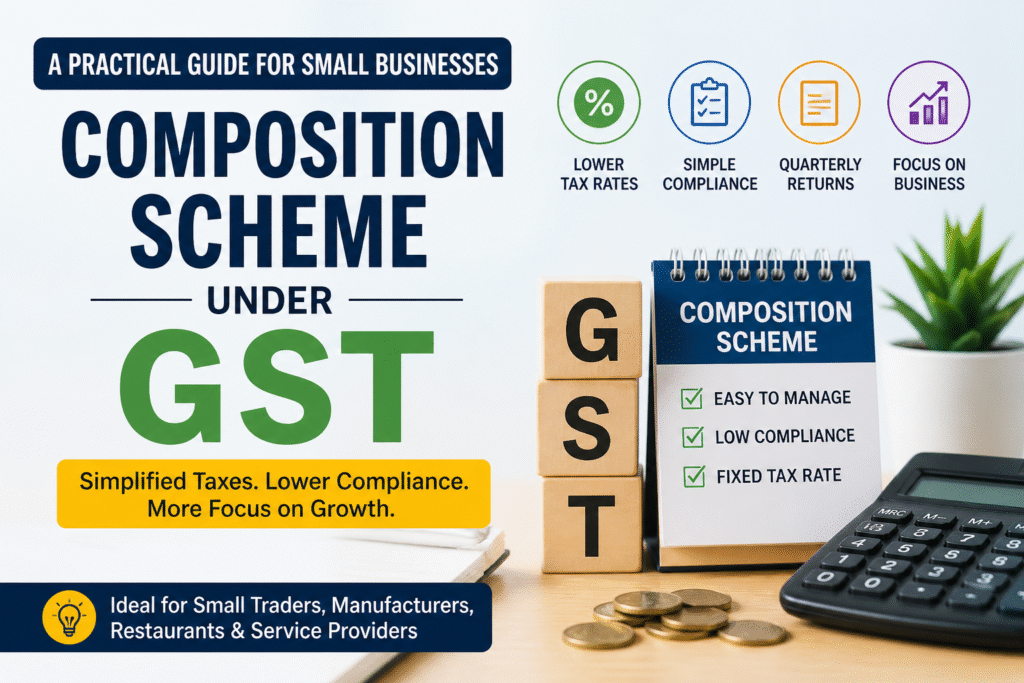
Composition Scheme under GST: A Practical Guide for Small Businesses
The Composition Scheme under Goods and Services Tax (GST) is a simplified taxation mechanism designed for small taxpayers to reduce compliance burden and ease tax payments. It is especially useful for small traders, manufacturers, and certain service providers who want to avoid complex GST procedures.
1. What is the Composition Scheme?
The Composition Scheme allows eligible taxpayers to pay GST at a fixed rate on turnover instead of the normal GST rates. In return, they are required to follow simplified compliance, including reduced return filing and minimal record-keeping.
2. Eligibility Criteria
A taxpayer can opt for the Composition Scheme if:
- Aggregate turnover in the preceding financial year does not exceed:
- ₹1.5 crore (₹75 lakh for special category states)
- The taxpayer is engaged in:
- Supply of goods (traders or manufacturers)
- Restaurant services (excluding alcohol)
- Limited service providers (under specific scheme up to ₹50 lakh)
3. GST Rates under Composition Scheme
| Category | GST Rate |
|---|---|
| Manufacturers | 1% |
| Traders (Suppliers of goods) | 1% |
| Restaurants | 5% |
| Service Providers (Composition Scheme) | 6% |
Note: Rates are calculated on total turnover, not profit.
4. Key Benefits
- Lower tax rates compared to regular GST
- Minimal compliance
- Quarterly return (CMP-08)
- Annual return (GSTR-4)
- No need for detailed records
- Easy calculation of tax liability
5. Limitations of Composition Scheme
- Cannot collect GST from customers
- Cannot claim Input Tax Credit (ITC)
- Not allowed for:
- Interstate supplies
- E-commerce sellers (like Amazon, Flipkart)
- Must issue Bill of Supply, not tax invoice
- Limited business expansion flexibility
6. Who Should Opt for It?
Composition Scheme is ideal for:
- Small shopkeepers
- Local traders
- Small manufacturers
- Restaurants with limited scale
- Freelancers or small service providers (under ₹50 lakh scheme)
It is suitable when:
- Your customers are end consumers (not businesses)
- You don’t need Input Tax Credit
- You want to reduce compliance burden
7. Who Should Avoid It?
Avoid the scheme if:
- You deal in interstate transactions
- Your clients require GST invoices and ITC
- You are scaling your business rapidly
- You sell through e-commerce platforms
8. How to Opt for Composition Scheme?
- File Form CMP-02 on GST portal before the beginning of the financial year
- For new registrations, choose composition option during registration
- Display “Composition Taxable Person” on business premises
9. Important Compliance
- File CMP-08 quarterly (tax payment)
- File GSTR-4 annually
- Maintain basic records of sales
- Issue Bill of Supply
10. Practical Example
If a trader has a turnover of ₹50 lakh:
- GST payable under composition = 1% of ₹50 lakh = ₹50,000
No need to calculate GST on each invoice, making it simple and predictable.
Conclusion
The Composition Scheme is a powerful option for small businesses that want simplicity over flexibility. However, it is not suitable for everyone. The decision should be based on your business model, customer type, and growth plans.
A careful evaluation can help you choose between regular GST and the composition scheme effectively.
Disclaimer
This content is created for educational and informational purposes only. It should not be considered as professional advice. Readers are advised to consult a qualified tax professional or refer to the latest provisions under GST law before making any decisions.