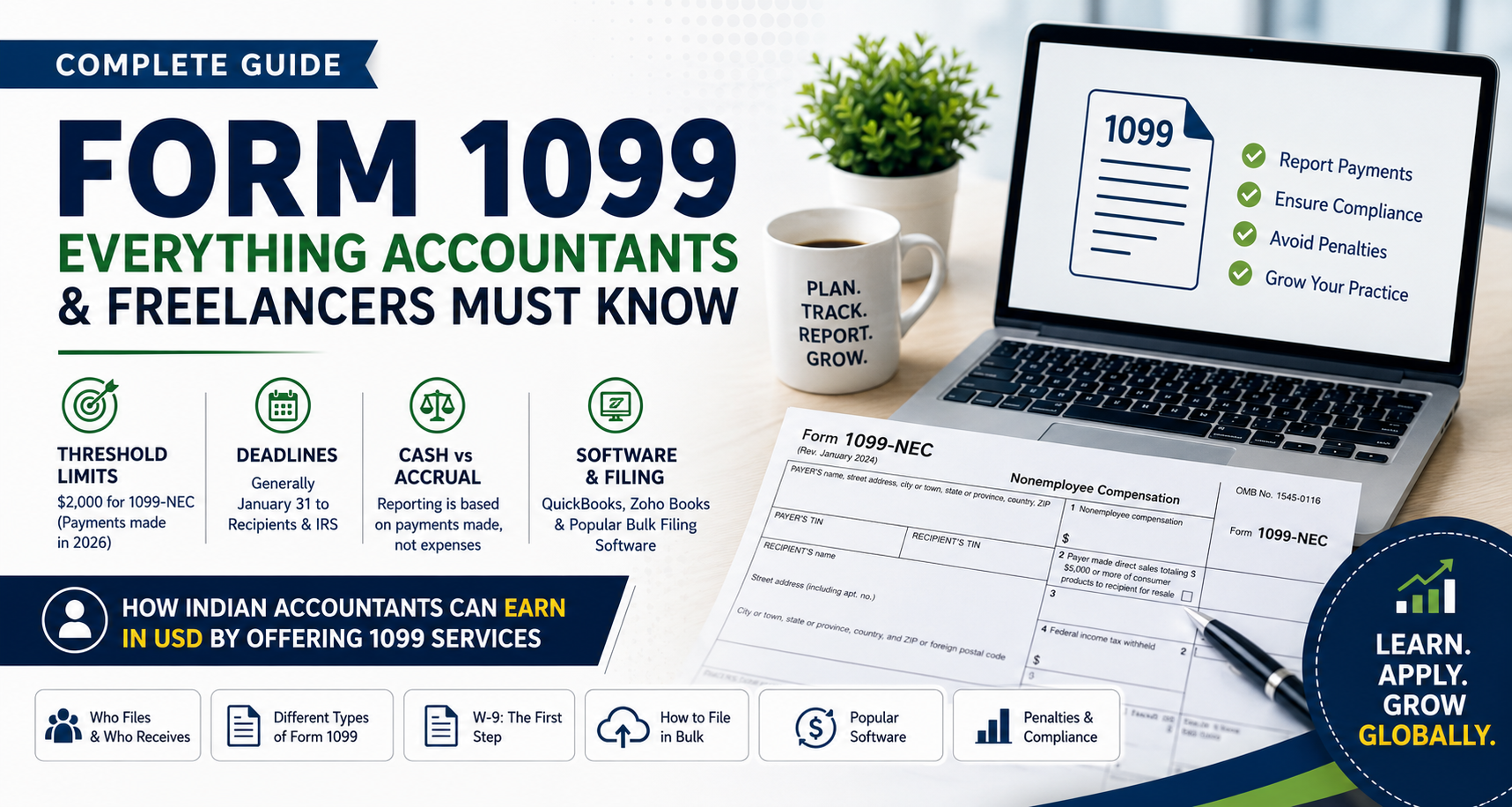
What Is Form 1099? Complete Beginner’s Guide to Threshold Limits, Deadlines, and How Indian Accountants Can Earn from This Skill
Form 1099 is one of the most important tax reporting forms in the United States. Businesses use it to report certain payments made during the year to freelancers, independent contractors, landlords, investors, and others.
If you are an accountant, bookkeeper, freelancer, business owner, or someone interested in U.S. accounting, this comprehensive guide explains:
- What Form 1099 is
- Who files it
- Threshold limits
- Filing deadlines
- Cash vs accrual treatment
- How to prepare and file it using QuickBooks and Zoho Books
- Popular bulk filing software
- How Indian accountants can earn by providing 1099 services
Table of Contents
- What Is Form 1099?
- Common Types of Form 1099
- Who Must File Form 1099?
- Who Receives Form 1099?
- Threshold Limits
- Filing Deadlines
- Why Form 1099 Is Filed
- Form 1099 vs W-2
- Related Form W-9
- Cash Basis vs Accrual Basis
- How to Prepare Form 1099 in QuickBooks
- How to Prepare Form 1099 in Zoho Books
- Popular Software Used to File 1099 in Bulk
- Real-World Filing Workflow
- Penalties for Late Filing
- How Indian Accountants Can Earn from Form 1099 Services
- Skills Required
- Frequently Asked Questions
- Final Thoughts
What Is Form 1099?
Form 1099 is a series of information returns used to report various types of income other than employee wages.
The Internal Revenue Service (IRS) uses these forms to match income reported by businesses with income reported by recipients.
In simple words:
- Employees receive Form W-2.
- Freelancers and independent contractors may receive Form 1099.
Common Types of Form 1099
Form 1099-NEC
Used to report nonemployee compensation paid to freelancers and independent contractors.
Form 1099-MISC
Used to report certain miscellaneous payments, including some rents and other reportable items.
Form 1099-INT
Used to report interest income.
Form 1099-DIV
Used to report dividend income.
Form 1099-K
Used to report certain payment card and third-party network transactions.
Who Must File Form 1099?
Businesses and organizations that make reportable payments may need to file Form 1099.
Examples include:
- Sole proprietorships
- Partnerships
- Corporations
- LLCs
- Nonprofits
Typical filers:
- Small business owners
- CPA firms
- Real estate companies
- E-commerce businesses
- Professional service firms
Who Receives Form 1099?
Recipients may include:
- Freelancers
- Consultants
- Accountants
- Virtual assistants
- Designers
- Developers
- Landlords
- Investors
Threshold Limits
Thresholds vary by form.
Form 1099-NEC
- Historically, the threshold has generally been $600.
- For payments made in 2026, the threshold increases to $2,000 under current law.
Form 1099-MISC
Many payment categories have historically used a $600 threshold, though some categories differ.
Form 1099-INT
Generally $10 or more.
Form 1099-DIV
Generally $10 or more.
Always verify the latest IRS instructions because rules can change.
Filing Deadlines
Form 1099-NEC
Generally due to both the recipient and the IRS by January 31.
Other 1099 Forms
Recipient copies are generally due by January 31, while IRS filing deadlines may vary.
If the due date falls on a weekend or federal holiday, the deadline moves to the next business day.
Why Form 1099 Is Filed
The IRS uses Form 1099 to:
- Match payer and recipient records
- Ensure income is reported accurately
- Reduce tax underreporting
Failure to file required forms can result in penalties.
Form 1099 vs W-2
| Form W-2 | Form 1099 |
|---|---|
| Issued to employees | Issued for certain nonemployee and other reportable payments |
| Payroll taxes are withheld | Generally no withholding |
| Employer-employee relationship | Independent contractor relationship |
Related Form W-9
Before issuing a 1099, businesses often collect Form W-9 to obtain:
- Legal name
- Business name
- Taxpayer Identification Number (TIN)
- Federal tax classification
Without a W-9, filing becomes difficult and may trigger backup withholding.
Cash Basis vs Accrual Basis
A common question is whether the reporting threshold depends on the accounting method.
Key Rule
Form 1099 is generally based on amounts actually paid during the calendar year.
Example
- Expense recorded in December 2026: $2,500
- Payment made in January 2027
Result:
- Not reported on the 2026 Form 1099
- Reported on the 2027 Form 1099
Conclusion
Whether the business uses cash basis or accrual basis accounting, Form 1099 reporting is generally based on payments made.
How to Prepare Form 1099 in QuickBooks
QuickBooks helps automate the entire process.
Steps
- Mark vendors as 1099 eligible.
- Enter W-9 information.
- Track payments throughout the year.
- Run the 1099 report.
- Review exceptions.
- Export or e-file.
Benefits
- Automatic tracking
- Built-in reports
- Reduced manual work
How to Prepare Form 1099 in Zoho Books
Zoho Books can be used to:
- Maintain vendor records.
- Store tax information.
- Track annual payments.
- Generate vendor payment reports.
- Export data for filing.
Benefits
- Easy vendor management
- Clean reporting
- Suitable for outsourced accounting teams
Popular Software Used to File 1099 in Bulk
Tax1099
One of the most popular platforms used by CPA firms.
Track1099
Widely used for bulk imports and electronic filing.
Avalara 1099 & W-9
Enterprise-grade compliance solution.
Yearli
Popular among payroll and accounting firms.
IRS FIRE System
The IRS electronic filing platform used directly or through software providers.
Real-World Filing Workflow Used by CPA Firms
- Collect W-9 forms.
- Track payments in QuickBooks or Zoho Books.
- Run the 1099 report.
- Export data to Excel or CSV.
- Upload to Tax1099 or Track1099.
- Review errors.
- E-file with the IRS.
- Send copies to recipients.
Large firms can file hundreds or thousands of forms in one batch.
Penalties for Late Filing
The IRS may assess penalties if:
- Forms are filed late
- Recipient copies are not sent on time
- Information is incorrect
- Required forms are not filed
Penalty amounts depend on the severity and timing of the failure.
How Indian Accountants Can Earn from Form 1099 Services
This is one of the most exciting opportunities for Indian accountants.
Every year in January, millions of businesses in the United States must issue Forms 1099 to vendors and contractors.
Many U.S. CPA firms and small businesses outsource this work to professionals in India.
Why This Is a Great Opportunity
- Seasonal but high-demand service
- Repetitive and process-driven
- Can be handled remotely
- Requires strong accounting and software skills
- Opportunity to earn in U.S. dollars
Services Indian Accountants Can Offer
- Collecting and reviewing W-9 forms
- Cleaning vendor data
- Identifying 1099-eligible vendors
- Running 1099 reports in QuickBooks and Zoho Books
- Preparing CSV files
- Uploading data to Tax1099 or Track1099
- Reviewing filing confirmations
- Communicating with clients regarding missing information
Typical Pricing in the U.S.
U.S. firms may charge clients:
- $100 to $300 for small batches
- $500 to $2,000+ for larger engagements
- Additional charges per form filed
What Indian Accountants Can Earn
Depending on experience and client size, Indian professionals may earn:
- $10 to $30 per hour
- $100 to $500 per small project
- $1,000 to $5,000+ during the January filing season
Experienced professionals serving multiple clients can earn significantly more.
Example Income Scenario
Suppose you handle 10 U.S. clients.
Average earnings per client during filing season: $300
Total seasonal revenue:
10 × $300 = $3,000
At an exchange rate of ₹85 per USD:
$3,000 ≈ ₹2,55,000
This can be earned in a few weeks during January and early February.
Long-Term Opportunity
1099 work can be an entry point to higher-value services such as:
- Bookkeeping
- Payroll
- Sales tax
- Month-end closing
- Financial reporting
- Tax return preparation support
Many accountants start with 1099 projects and later secure ongoing monthly engagements.
Skills Required to Offer Form 1099 Services
To become job-ready, Indian accountants should learn:
- U.S. accounting basics
- Vendor setup and W-9 collection
- QuickBooks Online
- Zoho Books
- Excel and CSV handling
- Tax1099 or Track1099
- Client communication in English
Frequently Asked Questions
Is Form 1099 only for freelancers?
No. The 1099 series covers many different types of income.
Is income taxable even if no 1099 is received?
Yes. Taxable income generally must be reported whether or not a form is received.
Can Indian accountants prepare Form 1099?
Yes. With proper training, Indian accountants can provide this service remotely to U.S. clients.
Does the threshold depend on cash or accrual accounting?
No. Reporting is generally based on payments made during the calendar year.
Is this a good freelancing opportunity?
Absolutely. 1099 compliance is a highly practical and in-demand service that can lead to recurring U.S. accounting work.
Final Thoughts
Form 1099 is one of the most practical topics in U.S. accounting.
By understanding:
- Form W-9
- Form 1099
- Threshold limits
- Filing deadlines
- Payment-based reporting
- QuickBooks and Zoho Books workflows
- Bulk filing software
you can build a valuable global skill.
For Indian accountants, this is more than a tax form—it is a real opportunity to earn in U.S. dollars and build an international accounting career.
If you are a commerce graduate, accountant, or tax professional, mastering Form 1099 can be your first step toward working with U.S. CPA firms and international clients.
If you want to become a U.S. Accounting Professional and earn in dollars from India, join my practical training program today.