Introduction
If you’re looking to build a rewarding career in US taxation, becoming an Enrolled Agent (EA) is one of the best professional certifications you can pursue.
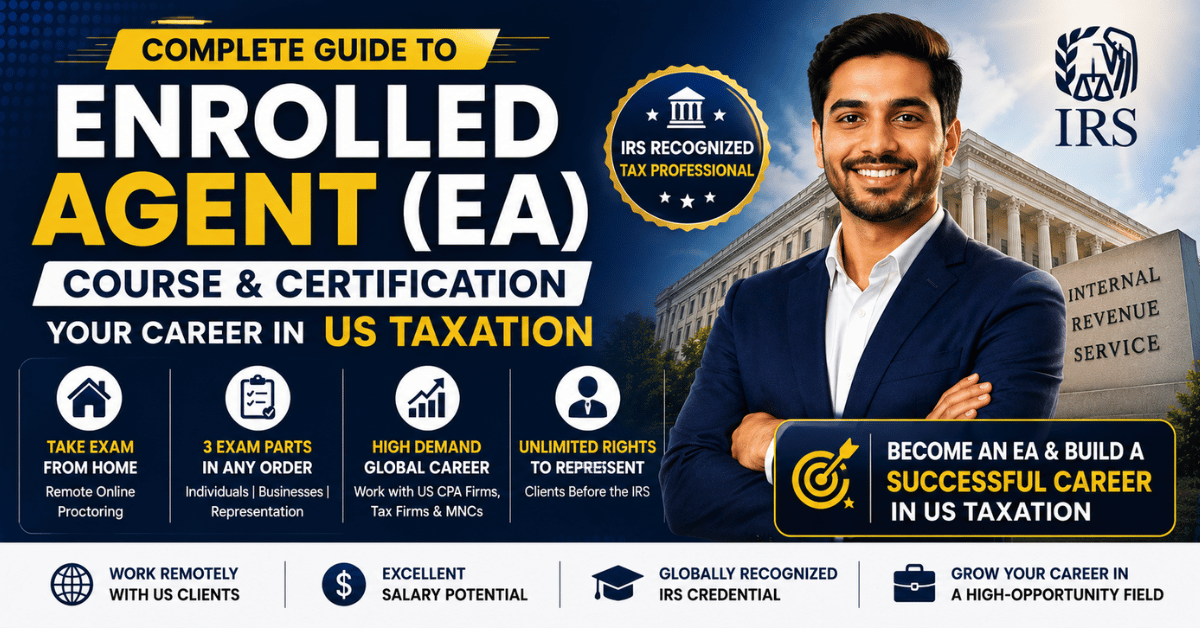
An Enrolled Agent is a tax professional authorized by the Internal Revenue Service (IRS), USA to represent taxpayers before the IRS. The EA credential is recognized worldwide and is highly valued by CPA firms, accounting outsourcing companies, multinational corporations, and tax consulting firms serving US clients.
With increasing demand for US tax professionals and the flexibility to take the exam remotely, the EA certification has become an excellent career option for commerce students, accountants, Chartered Accountants, finance professionals, and anyone interested in US taxation.
In this guide, you’ll learn everything about the Enrolled Agent course, including eligibility, syllabus, exam structure, certification process, fees, career opportunities, and frequently asked questions.
What is an Enrolled Agent (EA)?
An Enrolled Agent (EA) is a federally authorized tax practitioner licensed directly by the Internal Revenue Service (IRS).
Enrolled Agents have unlimited rights to represent taxpayers before the IRS, including individuals, partnerships, corporations, trusts, estates, and other entities.
Unlike a CPA, which is licensed by a U.S. state board and covers accounting, auditing, and taxation, an Enrolled Agent specializes exclusively in US Federal Taxation.
Because the credential is issued directly by the IRS, it is one of the highest and most respected certifications in the field of US taxation.
Why Should You Become an Enrolled Agent?
The demand for US tax professionals is increasing rapidly due to the growth of:
- US accounting outsourcing
- Remote work opportunities
- CPA firms hiring global talent
- Tax compliance requirements
- International accounting services
Some of the biggest benefits of becoming an EA include:
IRS-Issued Credential
The EA designation is issued directly by the Internal Revenue Service (IRS), making it one of the most respected credentials in US taxation.
Global Career Opportunities
EA-certified professionals are hired by companies around the world that serve US clients.
High Demand
Thousands of accounting firms actively recruit professionals with expertise in US taxation.
Remote Work Opportunities
Many Enrolled Agents work remotely for US CPA firms and tax practices.
Better Salary Potential
Specialized US tax professionals generally earn more than professionals with only domestic taxation knowledge.
Unlimited Representation Rights
An EA can represent taxpayers before the IRS for audits, appeals, collections, and other tax matters.
Who Should Pursue the EA Course?
The EA course is ideal for:
- B.Com Students
- B.Com Graduates
- M.Com Graduates
- Chartered Accountants (CA)
- Cost & Management Accountants (CMA)
- Company Secretaries (CS)
- MBA (Finance)
- Accountants
- Tax Consultants
- Bookkeepers
- Finance Professionals
- Audit Professionals
- Anyone interested in building a career in US Taxation
Eligibility Criteria
One of the biggest advantages of the Enrolled Agent (EA) certification is that the IRS does not prescribe any minimum educational qualification to appear for the Special Enrollment Examination (SEE).
This means you do not need a college degree to take the EA exam.
Even if you are:
- Commerce Student
- Pursuing Graduation
- Working Professional
you can register for the EA examination.
While there is no minimum educational qualification, candidates with a background in accounting, commerce, or taxation generally find the course easier to understand.
If you are from a non-commerce background, you can still pursue the EA certification with proper guidance and preparation.
Note: Passing the EA exam alone does not automatically make you an Enrolled Agent. After passing all three exam parts, you must also complete the IRS enrollment process, including obtaining a PTIN, submitting Form 23, and successfully completing the IRS suitability review.
What Will You Learn in the EA Course?
The EA course focuses entirely on US Federal Taxation.
The curriculum covers:
- Individual Taxation
- Business Taxation
- Corporate Taxation
- Partnership Taxation
- Trust Taxation
- Estate & Gift Tax
- Tax Planning
- IRS Procedures
- Circular 230
- Tax Research
- Ethics
- IRS Representation
- Tax Compliance
- Tax Return Preparation
EA Exam Structure
The Special Enrollment Examination (SEE) consists of three independent exam parts.
Part 1 – Individuals
Topics include:
- Filing Status
- Gross Income
- Adjustments
- Deductions
- Credits
- Retirement Income
- Property Transactions
- Individual Tax Returns
- Tax Calculations
Part 2 – Businesses
Topics include:
- Sole Proprietorship
- Partnerships
- LLC Taxation
- C Corporations
- S Corporations
- Business Deductions
- Depreciation
- Accounting Methods
- Trusts
- Estates
- Gift Tax
Part 3 – Representation, Practices & Procedures
Topics include:
- Circular 230
- Ethics
- IRS Audits
- Appeals
- Collections
- Penalties
- Client Representation
- Practice Before the IRS
- Professional Responsibilities
EA Exam Pattern
Each exam part consists of:
- 100 Multiple Choice Questions
- 85 Scored Questions
- 15 Unscored Pretest Questions
- 3.5 Hours of Exam Time
- Computer-Based Examination
Each exam part is independent and can be taken separately.
Passing Score
The EA examination uses a scaled scoring system.
- Score Range: 40–130
- Passing Score: 105
Each exam part is evaluated independently.
Do You Need to Take All Three Exams Together?
No.
One of the biggest advantages of the EA exam is its flexibility.
You can:
- Take one exam at a time.
- Take the exams in any order.
- Schedule the exams according to your preparation.
This makes the certification ideal for both students and working professionals.
What Happens If You Fail an Exam?
If you do not pass one exam part:
- You only need to retake the failed part.
- Previously passed parts remain valid within the IRS completion timeline.
- You do not need to repeat all three papers.
How Long Does It Take to Complete the EA Course?
The duration depends on your study schedule.
Full-Time Students
Approximately 3–6 months
Working Professionals
Approximately 6–12 months
Many candidates successfully prepare while working full-time.
Can You Take the EA Exam from Home?
Yes.
The IRS currently allows eligible candidates to take the Special Enrollment Examination through Remote Online Proctoring (ROP) using the official testing provider, PSI Services.
Candidates can choose between:
- Remote Online Proctored Exam (from home)
- Authorized PSI Testing Center (where available)
To take the exam remotely, you will need:
- Windows or Mac computer
- Stable internet connection
- Webcam
- Microphone
- Government-issued photo ID
- Quiet private room
- Clean desk without unauthorized materials
A live online proctor monitors the examination through your webcam, microphone, and screen sharing to maintain exam integrity.
EA Certification Process
Step 1
Obtain a Preparer Tax Identification Number (PTIN) from the IRS.
Step 2
Enroll in an EA preparation course.
Step 3
Create an account with the official testing provider.
Step 4
Schedule your preferred exam part.
Step 5
Appear for the examination through:
- Remote Online Proctoring
- Authorized Testing Center
Step 6
Pass all three parts of the Special Enrollment Examination (SEE).
Step 7
Submit Form 23 to the IRS.
Step 8
Complete the IRS suitability review.
Step 9
Receive your official Enrolled Agent credential.
EA Course Fees
The overall cost generally includes:
| Particular | Approximate Cost |
|---|---|
| PTIN Registration | As prescribed by IRS |
| EA Exam Fee | Per exam part |
| Number of Exam Parts | 3 |
| IRS Enrollment Fee | Applicable at the time of enrollment |
Note: Fees may change over time. Always check the official IRS website or the official testing provider for the latest fee structure.
Skills You Will Gain
After completing the EA course, you will develop expertise in:
- US Federal Taxation
- Individual Taxation
- Business Taxation
- Tax Return Preparation
- Tax Planning
- IRS Representation
- Tax Research
- Circular 230
- Professional Ethics
- Client Communication
- Tax Compliance
Career Opportunities After EA
After becoming an Enrolled Agent, you can work as:
- US Tax Associate
- Tax Analyst
- Tax Consultant
- Senior Tax Associate
- Tax Reviewer
- Tax Manager
- Tax Advisor
- US Tax Specialist
- Remote Tax Professional
- Tax Resolution Specialist
You can also establish your own US tax consulting practice or work independently with international clients.
Types of Companies That Hire Enrolled Agents
EA-certified professionals are hired by:
US CPA Firms
Providing tax preparation, tax planning, and IRS representation services.
Accounting Outsourcing Companies
Serving US accounting and taxation clients from India and other countries.
Tax Preparation Firms
Specializing in individual and business tax return preparation.
Bookkeeping Firms
Providing bookkeeping, payroll, and tax compliance services.
KPO & BPO Companies
Offering finance and accounting outsourcing services.
Consulting Firms
Providing tax advisory and compliance solutions.
Multinational Companies (MNCs)
Managing international tax and finance operations.
Independent Tax Practices
Many Enrolled Agents establish their own consulting firms or work as freelancers.
EA vs CPA
| Feature | Enrolled Agent (EA) | CPA |
|---|---|---|
| Issued By | IRS | State Board of Accountancy |
| Primary Focus | US Federal Taxation | Accounting, Audit, Taxation |
| Representation Rights | Unlimited before IRS | Depends on State License |
| Exam Parts | 3 | Usually 4 |
| Best For | Tax Specialists | Accounting & Audit Professionals |
Frequently Asked Questions (FAQs)
What does EA stand for?
EA stands for Enrolled Agent, a federally authorized tax practitioner licensed by the IRS.
Can 10th or 12th pass students pursue the EA course?
Yes. The IRS does not prescribe any minimum educational qualification for taking the Special Enrollment Examination (SEE). However, since the syllabus focuses on US taxation, candidates with little or no accounting background may need additional preparation.
Can Indian students become Enrolled Agents?
Yes. Indian candidates can take the EA examination and become Enrolled Agents after meeting all IRS requirements.
Can I take the EA exam from home?
Yes. Eligible candidates can take the examination through Remote Online Proctoring using the official testing platform.
Do I need a PTIN before registering?
Yes. Obtaining a Preparer Tax Identification Number (PTIN) is mandatory before scheduling the examination.
How many papers are there?
There are three independent exam parts.
Do I need to take all three exams together?
No. You can take each exam separately and in any order.
What is the passing score?
A scaled score of 105 is required to pass each exam part.
What happens if I fail one paper?
You only need to retake the failed paper. Previously passed papers remain valid within the allowed completion period.
Is there any age limit?
There is no specific age limit prescribed for taking the EA examination.
Is graduation compulsory?
No. A college degree is not mandatory for taking the EA examination.
Can Chartered Accountants pursue the EA certification?
Yes. Many Chartered Accountants pursue the EA credential to specialize in US taxation and expand their global career opportunities.
Is the EA certification recognized worldwide?
Yes. Since the credential is issued by the IRS, it is respected by employers serving US tax clients globally.
Can I work remotely after becoming an EA?
Yes. Many EA-certified professionals work remotely for US CPA firms, accounting firms, and tax advisory practices around the world.
Final Thoughts
The Enrolled Agent (EA) certification is one of the most respected credentials in the field of US taxation. It offers a clear pathway to global career opportunities, remote work, and specialization in US tax laws. Whether you are a student, accountant, Chartered Accountant, finance professional, or someone looking to transition into international taxation, the EA credential can help you build valuable expertise and expand your career prospects.
With flexible exam scheduling, the option to take the exam from home, and increasing demand for US tax professionals, there has never been a better time to start your journey toward becoming an Enrolled Agent.